
Private Cubicles vs. Traditional Private Offices
The debate over private offices or cubicles continues to shape workplace strategy. Companies weigh the classic closed-door office against flexible alternatives. In modern office workstation design, office cubicles with high walls often deliver comparable privacy at lower cost and greater adaptability. This comparison examines both options through practical, real-world lenses.
Understanding Traditional Private Offices
Traditional private offices feature full-height walls, a door, and complete enclosure. They offer visual and acoustic isolation. Executives and professionals handling sensitive information have long preferred them.
Construction and Space Demands
Construction requires permanent drywall or framed partitions. Changes demand demolition and rebuilding. Natural light often struggles to reach deeper floor areas once multiple private offices line the perimeter.
Advantages and Drawbacks
These spaces support deep concentration. Confidential conversations stay protected. Status signaling remains strong. Yet the drawbacks accumulate quickly. Higher construction and renovation costs limit scalability. Space efficiency drops because each office consumes more square footage. Collaboration can suffer when colleagues remain behind closed doors. Hybrid schedules leave many private offices empty for large portions of the week.
The Rise of Private Cubicles and Office Cubicles with High Walls
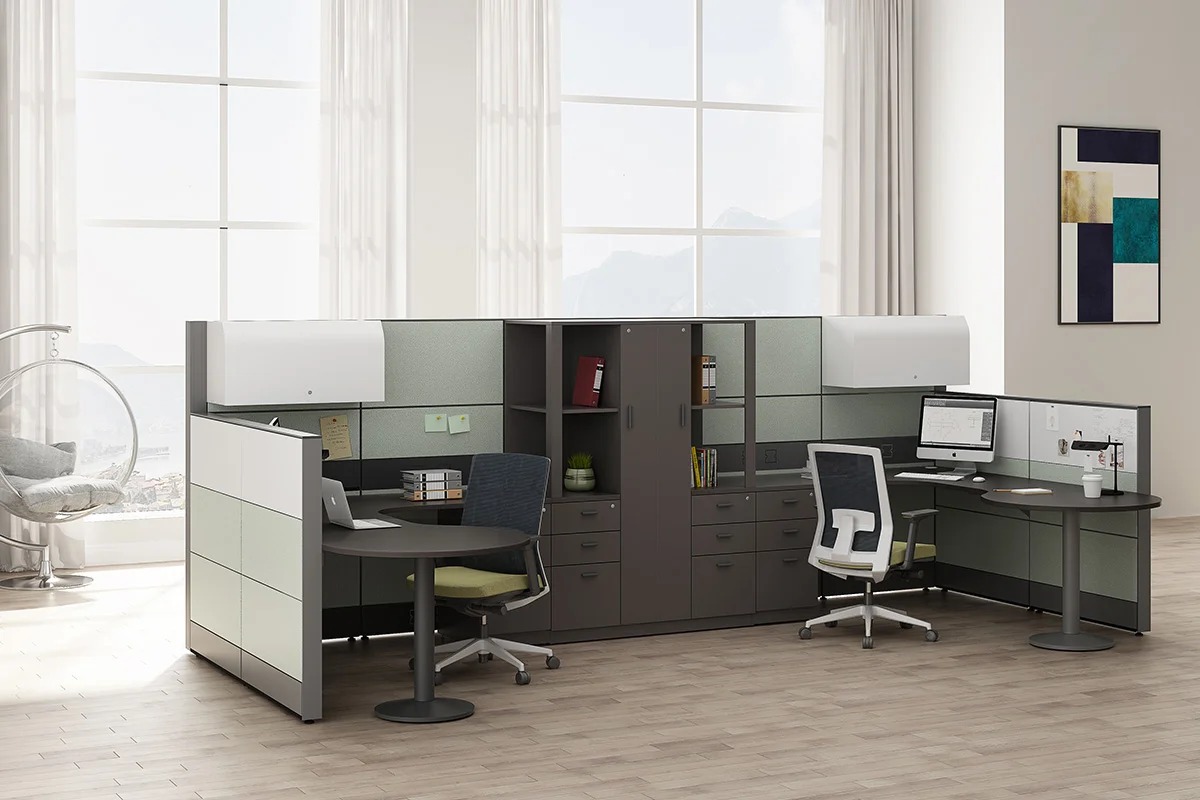
Private cubicles, especially office cubicles with high walls, provide a compelling middle path. Systems such as the T10 series use thick panels—often 83 mm—to create strong visual barriers and meaningful sound reduction. Workers gain focused personal zones without permanent construction. Modern office workstation design integrates these high-wall cubicles with height-adjustable desks, ergonomic seating, and smart storage.
Real-World Banking Application
In the America Bank project, sturdy 83 mm T10 partitions enclosed individual cubicles to enhance privacy and concentration. Ergonomically designed L-shaped adjustable workstations supported all-day comfort. Movable steel file cabinets and additional shelving kept documents secure. A circular conference table nearby enabled team discussions when needed. Blue-and-white tones reinforced a professional banking atmosphere.
Corporate Installation Example
The Las Vegas-Nevada installation followed a similar philosophy. The T10 office cubicle system delivered exceptional privacy while preserving an organized layout. Each station included an ergonomic workstation desk, task chair, and filing cabinet. Mobile writing boards supported quick collaboration. Training chairs with writing surfaces occupied adjacent zones for group sessions. Neutral finishes and natural light completed a clean, productive environment.
These examples illustrate how office cubicles with high walls achieve near-private-office performance inside a more flexible framework.
Key Differences in Privacy, Cost, and Flexibility
Privacy levels differ mainly in degree rather than kind. Traditional private offices deliver total enclosure. Office cubicles with high walls block most sightlines and reduce ambient noise significantly when panels reach proper height and thickness. Acoustic treatments further close the gap.
Cost and Scalability Factors
Cost structures favor cubicles. Permanent offices involve structural work, higher material expense, and longer installation timelines. Modular high-wall systems install faster and cost less per workstation. Future reconfiguration remains straightforward.
Flexibility Advantages
Flexibility represents the clearest advantage of modern cubicles. Layouts shift as teams grow or hybrid patterns change. Traditional offices resist such adjustments.
|
Feature |
Traditional Private Offices |
Private Cubicles / Office Cubicles with High Walls |
|
Privacy |
Complete visual & acoustic isolation |
High visual privacy; strong acoustic performance with thick panels |
|
Construction |
Permanent drywall or framed walls |
Modular panels, often 83 mm thick |
|
Cost per space |
Higher |
Lower to moderate |
|
Reconfiguration |
Difficult and expensive |
Fast and economical |
|
Natural light penetration |
Limited once perimeter is occupied |
Better distribution across the floor |
|
Storage & ergonomics |
Custom built-ins possible |
Integrated adjustable desks, under-desk cabinets, brackets |
|
Best suited for |
Senior executives, highly confidential roles |
Knowledge workers, finance teams, hybrid offices |
Modern Office Workstation Design Principles
Effective modern office workstation design prioritizes both focus and occasional collaboration. Office cubicles with high walls form the backbone. Height-adjustable or L-shaped desks promote movement and healthy posture. Filing cabinets and computer brackets keep surfaces clear. Neutral or professional color schemes maintain visual calm.
Integration of Ergonomics and Storage
In banking environments, the combination of high-wall cubicles and secure storage protects sensitive data while still allowing quick transitions to meeting tables. In general corporate settings, the same systems support individual deep work alongside nearby training or discussion zones. The result feels intentional rather than institutional.
Private offices or cubicles decisions therefore hinge on specific operational needs. When total isolation is non-negotiable, traditional offices remain relevant. When organizations value scalability, cost control, and balanced focus, office cubicles with high walls deliver superior long-term value.
Practical Implementation Considerations
Panel height and thickness matter. Walls above roughly 67 inches create stronger enclosure. Thicker constructions, such as 83 mm panels, improve both stability and sound absorption. Cable management channels keep technology tidy. Under-desk storage and overhead options maximize usable floor area.
Supporting Hybrid Work Patterns
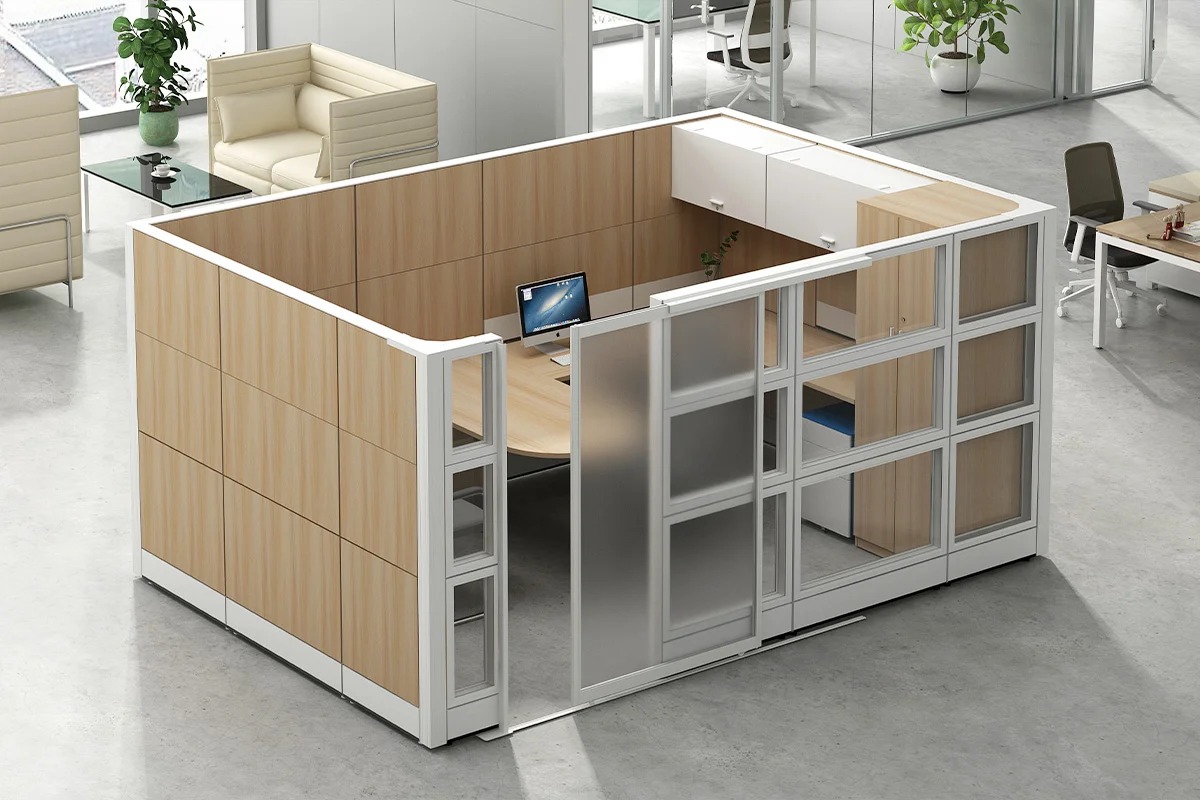
Hybrid work patterns further favor modular private cubicles. Unoccupied stations can be reassigned or temporarily opened. Traditional private offices sit idle more often. Employee feedback frequently highlights improved concentration inside well-designed high-wall cubicles compared with open-plan alternatives, while still preserving easier access to colleagues than fully enclosed rooms.
Conclusion
Choosing between private offices or cubicles no longer means sacrificing privacy. Office cubicles with high walls in modern office workstation design create focused, adaptable spaces that match traditional private offices. M&W Workstation offers modular high-wall systems—contact the team today for a consultation tailored to your needs.