
How a U.S. Bank Transformed Its Office into a Privacy-First, Ergonomic Workspace
The Hidden Cost of Open-Plan Offices
Open-plan offices were supposed to encourage collaboration. In practice, many become filled with overlapping conversations, constant movement, and endless small interruptions. For one U.S. bank, the stakes were higher than simple annoyance. Client information had to stay protected. Employees needed stretches of real concentration. The space also needed to project calm professionalism. What began as a contemporary layout gradually turned into a daily barrier to productive work. This project shows how that bank moved beyond the noise and created an environment that genuinely supports focus and security.
Why Traditional Open Layouts Struggle in Banking
Banks face tighter requirements than most workplaces. Visual privacy is essential because sensitive information cannot be casually seen. Acoustic privacy matters because conversations often involve confidential details. Staff typically spend long hours at their desks, so physical comfort and posture support become practical needs rather than optional features. Storage must be both secure and convenient. Meeting spaces still have to function without turning the whole floor into a noisy zone.
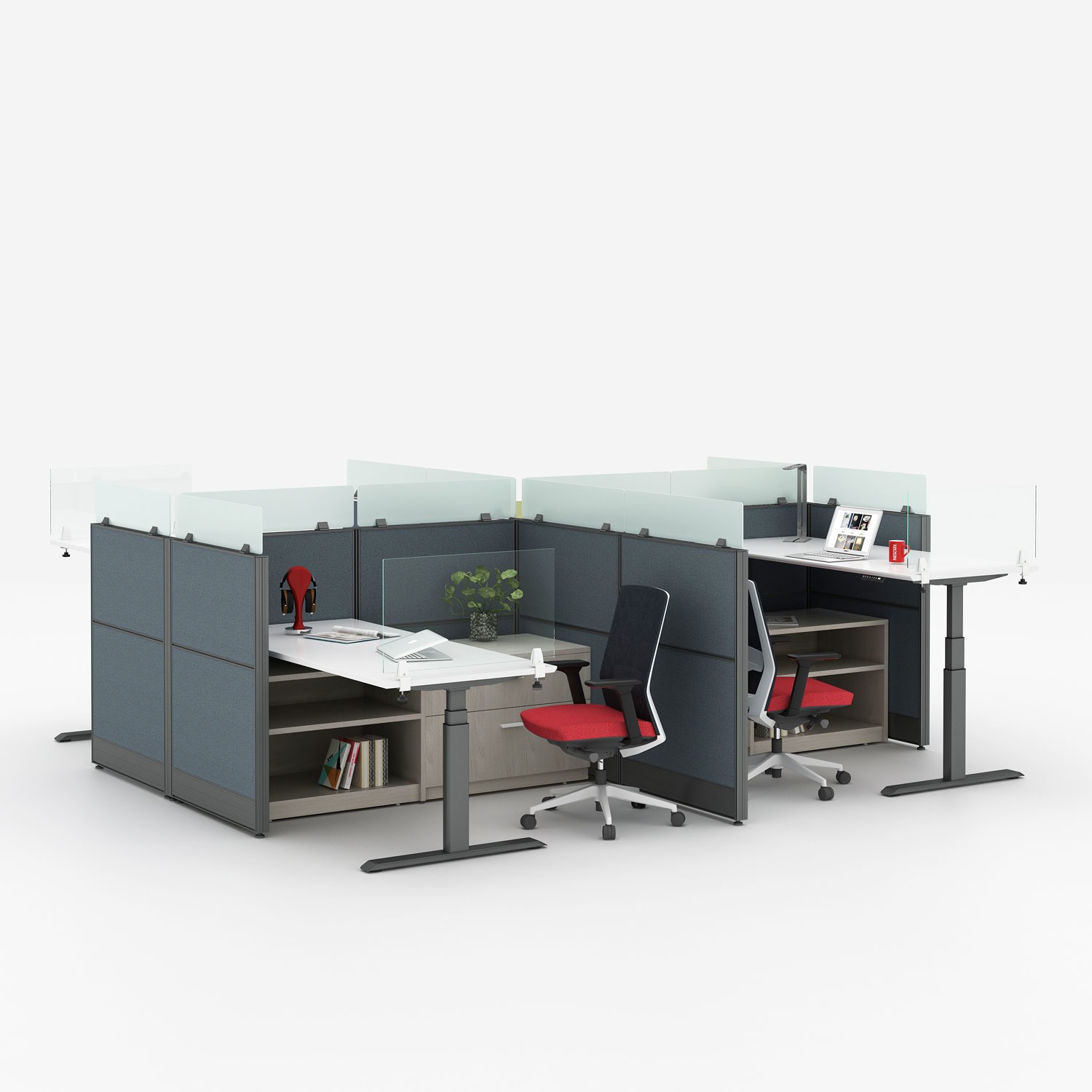
The earlier open arrangement fell short on several of these points at the same time. Desks offered almost no separation. Storage was limited and largely shared. Fixed-height surfaces left people feeling stiff by the afternoon. The overall appearance lacked the steady, professional tone expected in a financial setting. The bank required a coordinated response rather than a collection of unrelated furniture pieces.
How M&W Rebuilt the Space Layer by Layer
The project was treated as a complete workplace system instead of a simple furniture order. Each decision solved one clear problem and set up the next improvement.
Building Privacy That Actually Works
The first priority was separation. 83mm-thick T10 partitions formed individual cubicles, providing visual screening for bank staff handling customer records, confidential documents, and sensitive information displayed on screens. The added thickness also helps reduce ambient noise, creating personal zones where employees can focus on detailed tasks with fewer distractions. The layout maintained a semi-open environment for management visibility and team coordination while giving each employee a more private, dedicated workstation. Similar approaches appear in our office cubicle and partition systems.
Making Long Hours More Sustainable
Once privacy was established, attention shifted to the desks. L-shaped height-adjustable workstations replaced the old fixed surfaces. People can raise or lower the desk as needed during the day, which reduces the physical strain that accumulates over long shifts. The L-shape also supplies extra surface for dual screens, documents, and everyday banking tools. Together with the surrounding partitions, these stations became genuine focus areas rather than temporary stops. Full details on these models are available among our height-adjustable desks.
Securing Documents Without Creating Clutter
Storage followed next. Movable steel cabinets were placed under each desk so every employee has immediate, lockable space for personal and work materials. Additional filing units and shelves handled bulk documents and shared resources. The outcome is a cleaner desktop culture backed by proper security—an essential requirement in banking where document control cannot be compromised.
Keeping Collaboration and Professional Presence
The final layer restored the collaborative side of the office. A circular conference table was introduced for group discussions, allowing participants to face one another more naturally. Monitor arms kept screens at comfortable heights and freed desk space. The blue-and-white color scheme reinforced the bank’s professional identity without feeling cold or institutional.
All of these elements were produced and coordinated through M&W’s own manufacturing facilities. More than three decades of experience, high in-house production rates, and proven capacity for large projects made it possible to customize sizes, finishes, and configurations while keeping quality consistent and delivery reliable. Additional examples of completed work appear in the M&W case studies collection.
|
Aspect |
Before |
After |
|
Privacy & Focus |
Constant visual and noise interruption |
Defined zones with 83mm T10 partitions |
|
Daily Comfort |
Fixed desks, rising fatigue |
L-shaped height-adjustable workstations |
|
Document Security |
Limited shared storage |
Under-desk steel cabinets plus dedicated filing |
|
Meeting Style |
Noisy, unstructured |
Circular table supporting equal discussion |
|
Overall Impression |
Busy and unsettled |
Calm, professional blue-and-white finish |
What Changed Once the System Was in Place
The finished floor feels different in everyday use. Noise no longer travels as freely. People can settle into concentrated work without constant interruption. Desks support posture changes rather than forcing one fixed position. Documents stay secure yet accessible. Meeting areas still exist, but they no longer dominate the entire space. The visual tone matches the expectations of a financial institution. In short, the bank now has an environment that supports security, focus, and professional presence at the same time.
Why This Approach Matters Beyond Banking
The same pressures appear in many other sectors. Finance, healthcare, legal, and professional service firms all need places where people can concentrate, protect information, and still collaborate when required. The sequence used here—strong privacy first, then ergonomic support, then secure storage, then balanced meeting space—can be adapted to different industries and floor plates. M&W’s background as a manufacturer with long-term partnerships and large-scale delivery capacity makes that adaptation practical. More background on the company’s approach is available through Why Choose M&W.
Conclusion
For banks and other privacy-sensitive workplaces, improving productivity is not only about reducing noise; it is about creating a coordinated system where partitions, ergonomic workstations, secure storage, and meeting areas support daily operations together. This U.S. bank case shows how a privacy-first workspace can improve focus, protect sensitive information, and create a more professional office environment. To plan a similar project, share your floor plan or workspace requirements with M&W for a tailored layout proposal and product configuration recommendation.
FAQs
Q: What partition thickness works best for privacy in finance or banking offices?
A: Environments that handle confidential information usually benefit from partitions in the 60–83mm range or thicker. The 83mm T10 system used in this project offers solid visual and acoustic separation while remaining modular.
Q: Can the furniture be customized for banking or other regulated industries?
A: M&W regularly adjusts dimensions, finishes, locking storage, and layout details to meet specific industry needs, including finance, healthcare, and professional services.
Q: How long does a typical mid-to-large workstation project take?
A: Samples are often ready in about seven days. Larger installations involving thousands of positions can frequently be completed within roughly twenty days, depending on scope and destination.
Q: What is the advantage of a full system over buying separate pieces?
A: When partitions, desks, storage, and meeting elements are designed together, cable management, privacy performance, appearance, and future reconfiguration all work more smoothly and usually cost less over time.
Q: Are the products used on international projects?
A: M&W regularly delivers to North America, Asia, the Middle East, Africa, and Latin America, with experience meeting the quality and shipping expectations of those markets.