
Modular Open-Plan Workstations for Office Solutions: VOLTA
From a Single Desk to a Scalable Spatial System: Why the VOLTA Workstation Suits Large-Scale Office Projects
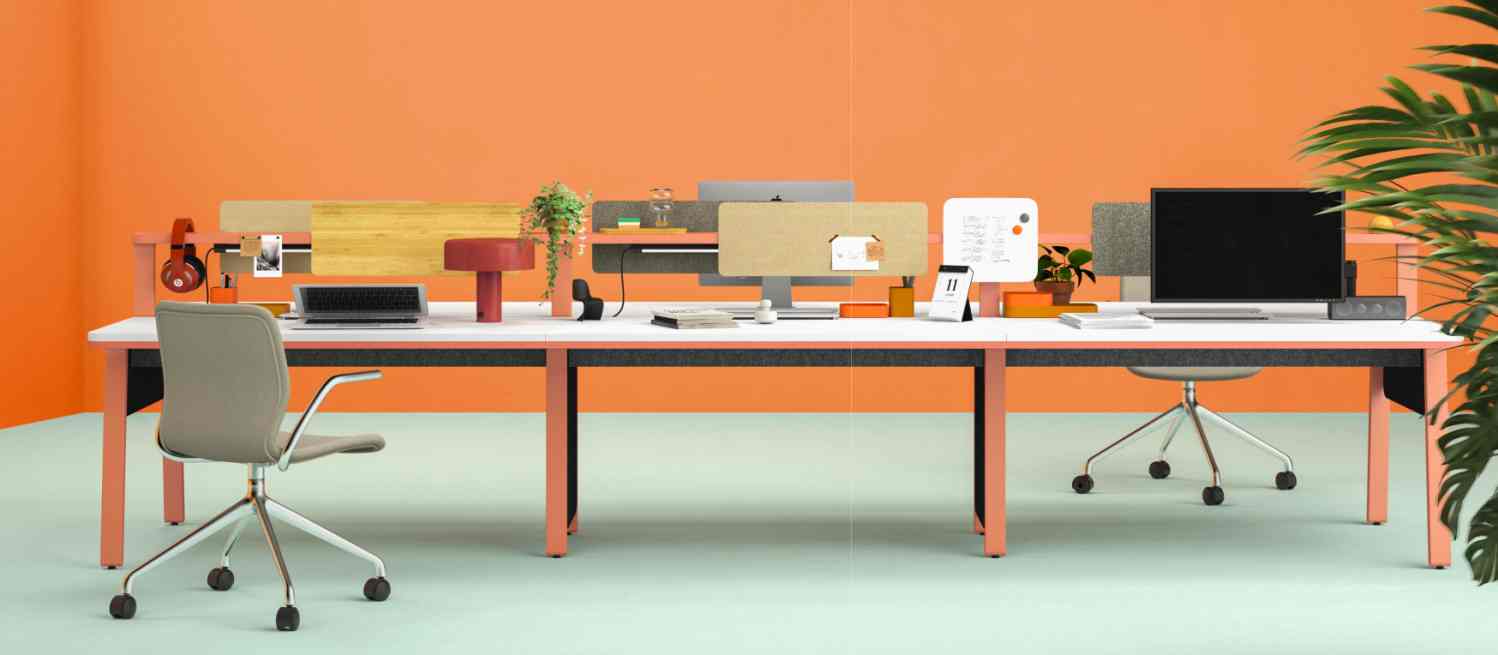
When undertaking overseas office projects, the factor most frequently underestimated is not the price of individual furniture pieces, but the cost of change. A design phase might specify 80 workstations, only for the requirement to shift to 96 before delivery; departments initially assigned fixed seating might switch to hot-desking once operational; and requirements regarding screen heights, desktop accessories, power outlets, and team boundaries may evolve alongside the nature of the roles. If standalone desks are purchased, every change necessitates re-ordering, re-cabling, and re-coordinating installation work. An open-plan workstation system truly suited for large-scale enterprise projects should be modular, scalable, and easy to maintain—much like an architectural system.
The core value of the M&W VOLTA series lies in "addressing non-standard needs with standard modules." The product range offers configurations such as two-person workstations, face-to-face multi-person setups, extension desks, executive desks, and high tables. Basic desktop widths range from 1,200 to 1,500 mm, with depths configurable at 600 or 700 mm; multi-person face-to-face units can scale from 2,400 mm to 3,000 mm, while extension units allow for further capacity increases. For architects and office design firms, this underlying logic is more significant than a mere catalog of models: by using basic units to establish endpoints and cable entry points, and then adding intermediate modules based on team size, one can plan layouts for small groups, entire departments, or even entire office floors using a consistent structural language.
In the Era of Hybrid Work, Workstation Count No Longer Equals Headcount
CBRE’s *2025 European Office Occupier Survey* reveals that 61% of surveyed companies have adopted non-fixed seating arrangements, while 88% are evaluating the effectiveness of their office space. With desk-sharing becoming the norm, project stakeholders need to manage peak occupancy, team adjacency, and temporary capacity expansion, rather than simply assigning one desk per employee based on total headcount.For project teams, this means workstation planning can no longer rely only on total headcount. The layout must also account for peak occupancy, team adjacency and the possibility of adding or reallocating seats later.
VOLTA’s modular structure allows for the seamless translation of "changes in headcount" into "changes in modular configuration." Two-person units can function as independent clusters; face-to-face configurations suit stable teams, while extension tables allow for continuous expansion. Executive desks share the same steel leg, panel, and color systems as staff workstations, ensuring management areas do not become stylistic outliers. For companies undergoing phased fit-outs, the initial phase can establish the core layout and basic units, with intermediate modules added later based on actual occupancy—thereby avoiding excessive upfront procurement.
Cable Management Starts Within the Desk Frame
In large open-plan offices, the visual impact of the finished space is often determined not by the desktop, but by what lies beneath. The VOLTA range features aluminum-plastic composite cable boxes and suspended cable trays; end panels, intermediate panels, and trays can be specified in PET or sound-absorbing materials depending on the model. Power and data cables are distributed along the continuous workstation structure, eliminating the need for a separate power strip for every additional seat.
This design offers three direct benefits to the project team. First, MEP consultants can position floor outlets or wall access points relative to the workstation spine, rather than pinpointing locations for every individual desk. Second, installers can complete the desk frames and cable trays before connecting desktop equipment, resulting in a clearer on-site workflow. Third, during the operational phase, replacing monitors, phones, or network equipment can be handled via the cable trays without disturbing the desktop or flooring surfaces.
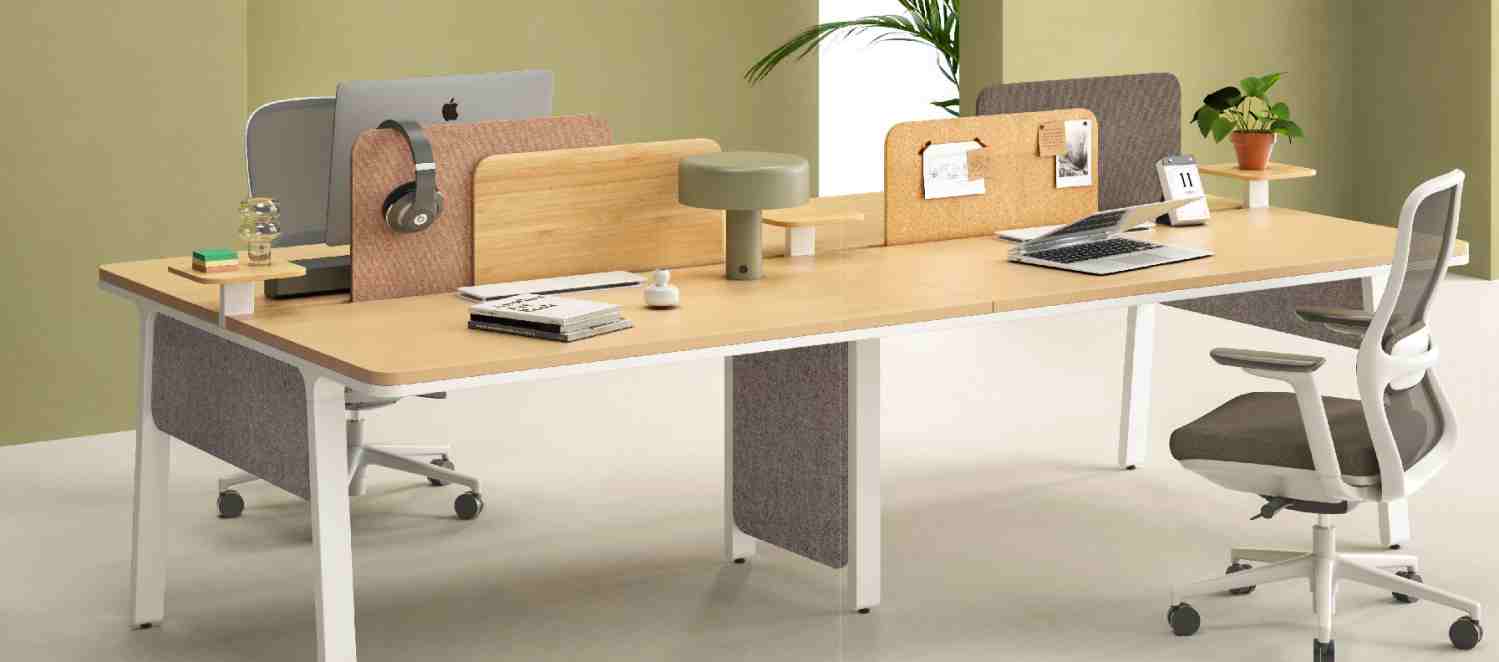
VOLTA executive desks also offer flip-top desktop power modules, while high-table configurations can incorporate power rails with standard sockets. From staff workstations and executive desks to short-term collaboration areas, power connectivity is integrated into the furniture system rather than added as an afterthought—a key distinction between a comprehensive solution and a standard furniture list.
Screens: More Than Just Dividers—They Are Functional Tools
VOLTA’s powder-coated aluminum screen frames support a variety of attachments, including bamboo panels, fabric panels, whiteboards, sliding boards, and lighting fixtures. The bamboo and fabric panels feature slim, modular designs and magnetic mounting; whiteboards offer a writable magnetic surface; and lighting fixtures utilize aluminum profiles, opal acrylic diffusers, and 4000K LED light sources. Various accessories can be combined to suit specific job tasks without requiring changes to the desk frame itself.
For instance, sales teams can use fabric screens to minimize visual distractions from neighbors; design teams can add whiteboards to track tasks; project teams can utilize trays and upright accessories to organize documents; and workstations requiring better lighting can be fitted with task lamps. Screens evolve from static partitions into interchangeable, functional interfaces, allowing the same set of workstations to serve different departments.
The significance of PET components extends beyond the "eco-friendly material" label. Speech-related noise in open-plan offices directly impacts concentration. A study of 1,078 employees in shared and open-plan offices found that irrelevant speech in open spaces correlates with higher noise annoyance and lower self-rated work performance. Therefore, sound-absorbing panels, screens, and spatial acoustics should be designed in conjunction with ceilings, carpeting, and quiet rooms. While furniture cannot replace comprehensive acoustic engineering, it serves as the primary interface for controlling sound propagation paths.
Material and Color Standardization Enables Cross-Regional Replication
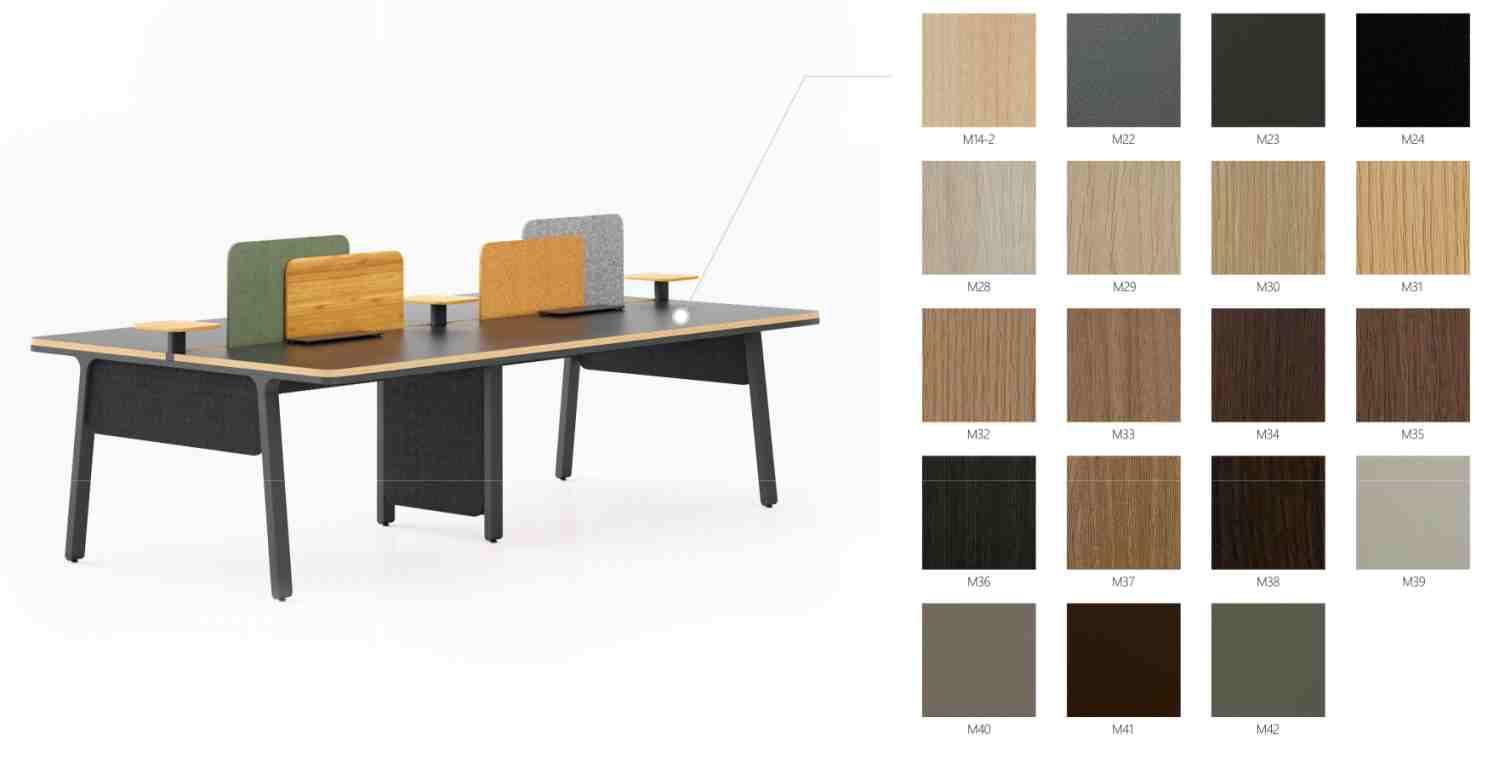
The VOLTA workstation system features 25mm MFC tabletops, powder-coated steel frames and legs, and powder-coated aluminum screen frames, with a range of color options for tabletops, steel structures, fabrics, and PET elements. Executive desks further incorporate 16mm MFC cabinetry, lacquered solid wood side panels, and beveled-edge pulls. A unified color palette allows designers to establish a "global standard color + local alternative color" strategy, maintaining brand consistency across international offices while offering flexibility in material sourcing and lead times.
For overseas projects, it is advisable to finalize details—such as tabletop finishes, PET color codes, screen types, power socket standards, cable tray capacity, and module counts—during the detailed design phase and to construct a complete mock-up workstation. Mock-up inspections should go beyond color checks to evaluate screen stability, cable bend radii, clearance for plugs, under-desk legroom, and the flushness of connections at extension units.
Why Seating Should Be Reviewed with the VOLTA Workstation System
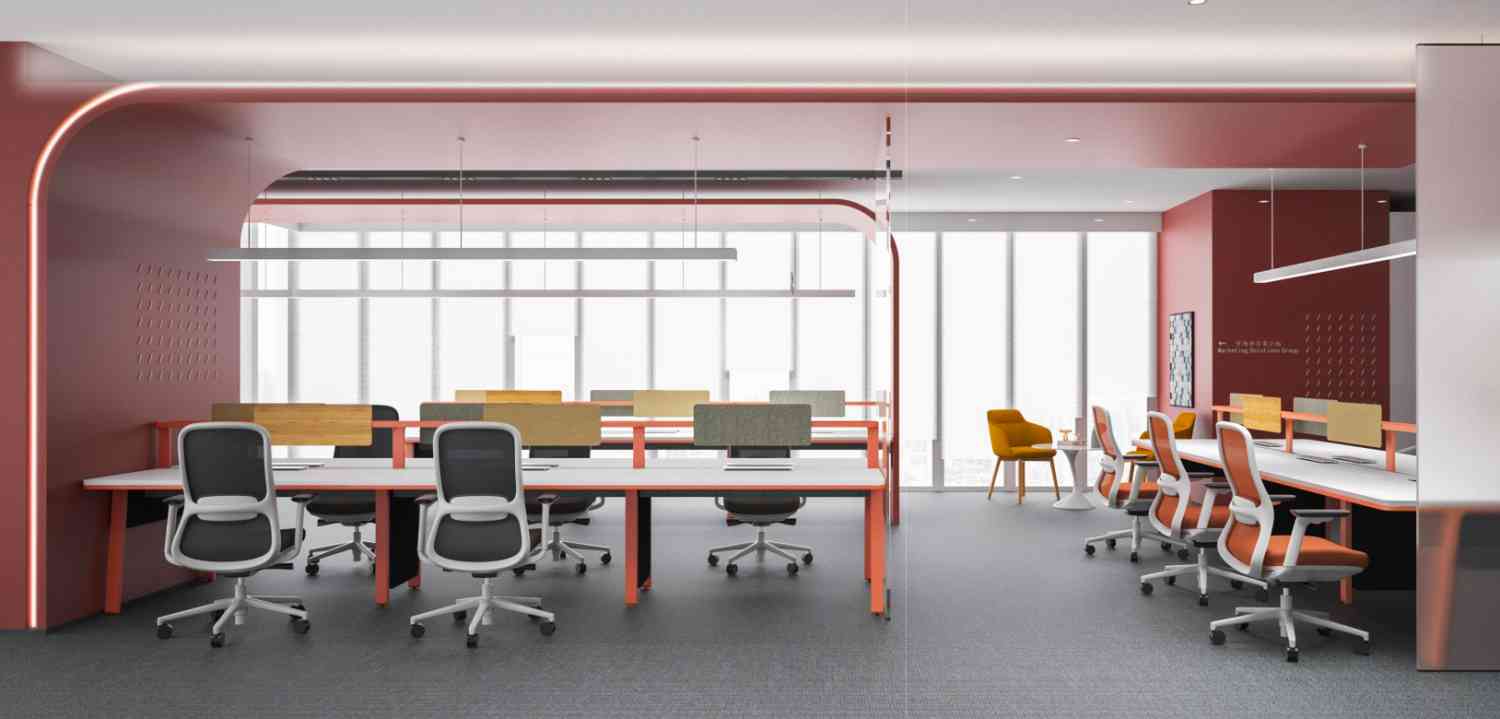
The VOLTA staff chair is designed for the high-frequency usage typical of open-plan workstations and caters to employees who spend long hours at their desks. It features an ergonomic structure with a height-adjustable gas lift and a synchronized tilt mechanism; the backrest dynamically follows the user's movements to alleviate lower back strain caused by prolonged sitting. Silent nylon casters ensure smooth, quiet mobility across various flooring types, working alongside PET acoustic screens to minimize noise in open-plan offices. The breathable mesh backrest offers zoned support, while adjustable armrests accommodate different desk depths (600/700mm), ensuring ample legroom beneath the desk. Color options allow for coordination with VOLTA workstation steel frames, PET acoustic components, and fabric screens, creating visual unity across the entire floor. Standardized structural design supports bulk packaging and rapid on-site assembly—ideal for large-scale overseas projects requiring phased delivery and installation—while interchangeable parts ensure low long-term maintenance costs.
Positioned as a premium counterpart to the staff chair, the manager chair complements the VOLTA executive desk, balancing a professional aesthetic with comfort for extended use. It features a reinforced five-star base—available in nylon or aluminum alloy—for superior load-bearing capacity. The thick, high-density foam seat cushion is available with either leather or premium mesh upholstery, offering a sleek, sophisticated look that harmonizes with the refined, solid-wood-veneer side panels of the executive desk. Optional features such as tilt locking, adjustable armrests, and headrests cater to the dual needs of focused long-term work and brief, face-to-face consultations. Precisely dimensioned to fit perfectly beneath the executive desk, the chair avoids interference with the desk structure or flip-top desktop power modules. From a project procurement perspective, staff chairs and manager chairs share a unified color palette system; design firms can select finishes and colors during the conceptual phase, thereby minimizing color discrepancies and coordination issues often associated with multiple suppliers. For large-scale overseas projects, seating must be included in the mockup workstation acceptance process to verify clearances, check for movement interference, and ensure color consistency. The integrated seating solution combines with VOLTA workstations to form a cohesive office furniture system—moving beyond a collection of disparate, individually procured items—to help builders and design firms streamline supply chains, reduce project touchpoints, and achieve a true one-stop office delivery solution.
The Key to One-Stop Delivery: Minimizing Interface Points
A mature VOLTA office solution applies a unified product logic across staff areas, executive zones, and short-term collaboration spaces. The project process should also evolve from merely "purchasing desks" to "planning a system": first, analyze departmental needs and headcount to establish workstation modules; plan power and network infrastructure based on equipment requirements; select screen accessories tailored to needs for focused work, collaboration, and display; and finally, standardize colors, packaging, installation sequences, and spare parts.
For major corporate clients, this ensures flexibility for future relocations or workforce expansions; for contractors and design firms, it means fewer coordination conflicts, clearly defined dimensional interfaces, and the ability to easily replicate standard floor layouts. What makes VOLTA truly worthy of promotion is not any single product, but rather its capacity to organize complex office environments using a limited set of modular components. An open-plan workstation system can only serve as the core of a comprehensive office furniture solution if it simultaneously addresses layout, cabling, acoustics, accessories, and adaptability for future changes.
Conclusion
Large office projects become harder to manage when workstation layouts, screens, power access and seating are sourced as separate decisions. VOLTA brings these elements into one modular planning framework, helping project teams respond more clearly to changing layouts, phased delivery and future expansion. Contact M&W today to discuss a scalable workstation solution for your next office project.