
Custom Call Center Workstations: A One-Stop Project Guide
Call center, shared-service, and BPO projects often require repeatable workstation modules, organized cabling, practical storage, and coordinated delivery. Instead of relying on broad market forecasts, buyers should evaluate how well each furniture system supports the project layout, equipment requirements, maintenance access, and installation schedule.
The two sets of data reflect the same trend: global customer service center, SSC, and BPO business expansion, and call center workstation procurement tends to be large-scale, standardized, and fast-delivery. For overseas builders, design companies and corporate buyers, one-stop office furniture solutions are the key to completing projects on time and on budget. Based on actual scenarios, this article disassembles the core configuration of the call center workstation system from the five dimensions of screen partitions, desktop cable management, storage systems, seat ergonomics, and color and material customization, and provides purchasing reference for overseas buyers.
I. Unique Requirements for Furniture Design in Call Center Workstation Systems
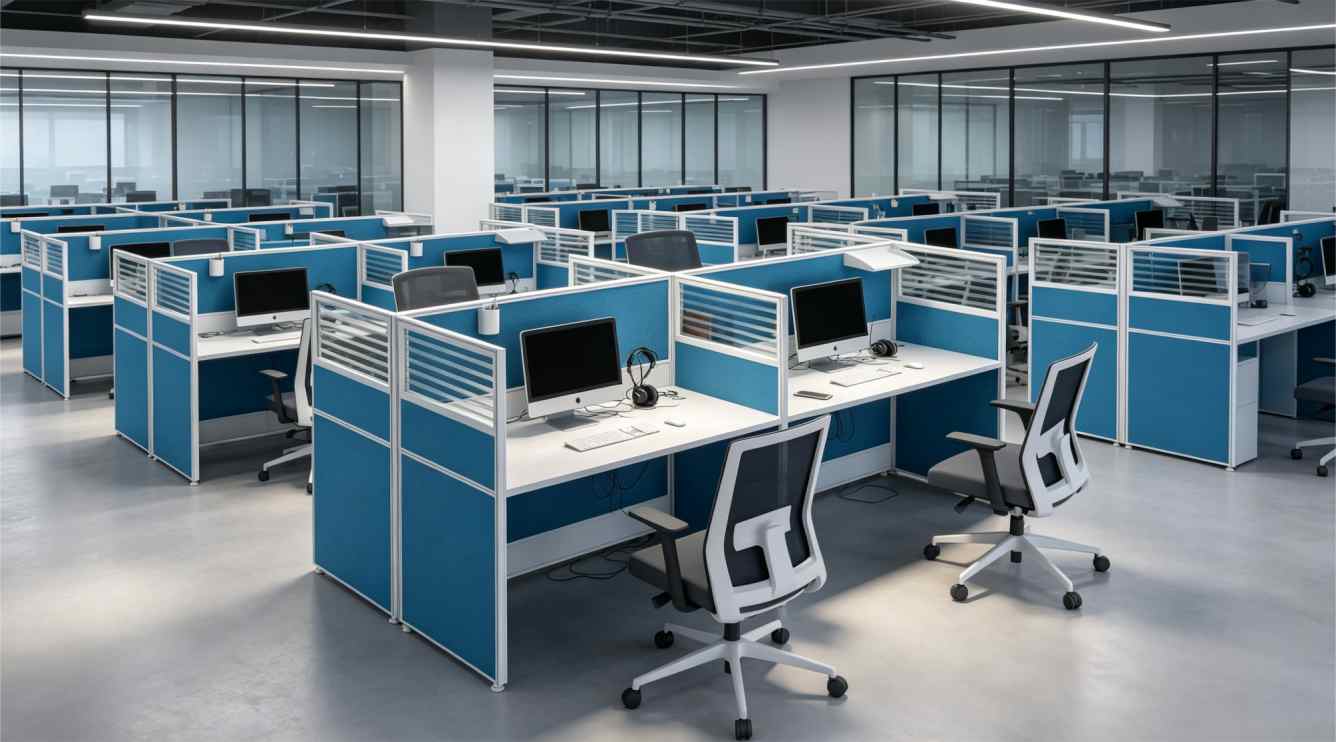
Unlike standard open-plan offices, call center environments are characterized by high-density workstation layouts, concentrated noise from simultaneous calls, and complex cabling and equipment. Employees work intensively while wearing headsets for extended periods; consequently, standard office furniture specifications cannot simply be applied. Instead, the design must meet four key requirements: utilizing partitions to provide acoustic and visual separation within high-density layouts; ensuring organized, concealed routing of cables and equipment that balances safety with ease of maintenance; employing modular, replicable designs suitable for bulk procurement and rapid assembly; and incorporating ergonomic principles to support employees during daily sedentary work exceeding seven hours, thereby safeguarding their health and productivity. A robust call center workstation system requires the seamless integration of multiple components—including partitions, desks, storage units, seating, and cable management—highlighting the value of a comprehensive, one-stop office furniture solution.
II. Screen Partitions: A Key Element for Noise Reduction and Focus Management
In call center environments, screen partitions serve a more critical function than those found at standard workstations. Built upon a robust 30mm-thick all-aluminum alloy frame, these screens offer customizable height, materials, and colors to meet specific project requirements. Taking the T3 Series 1650 configuration as an example, the system offers various combination options: a fully fabric-upholstered version without cable channels; a version featuring a fabric lower section, a transparent tempered glass upper section, and a bottom cable channel; and a premium fully fabric-upholstered version supporting dual cable channels. These options allow for flexible selection based on the project's specific priorities regarding acoustics and natural lighting. The screens are secured using metal brackets attached to 25mm-thick tabletops, ensuring structural stability and making them ideal for continuous, multi-station layouts.
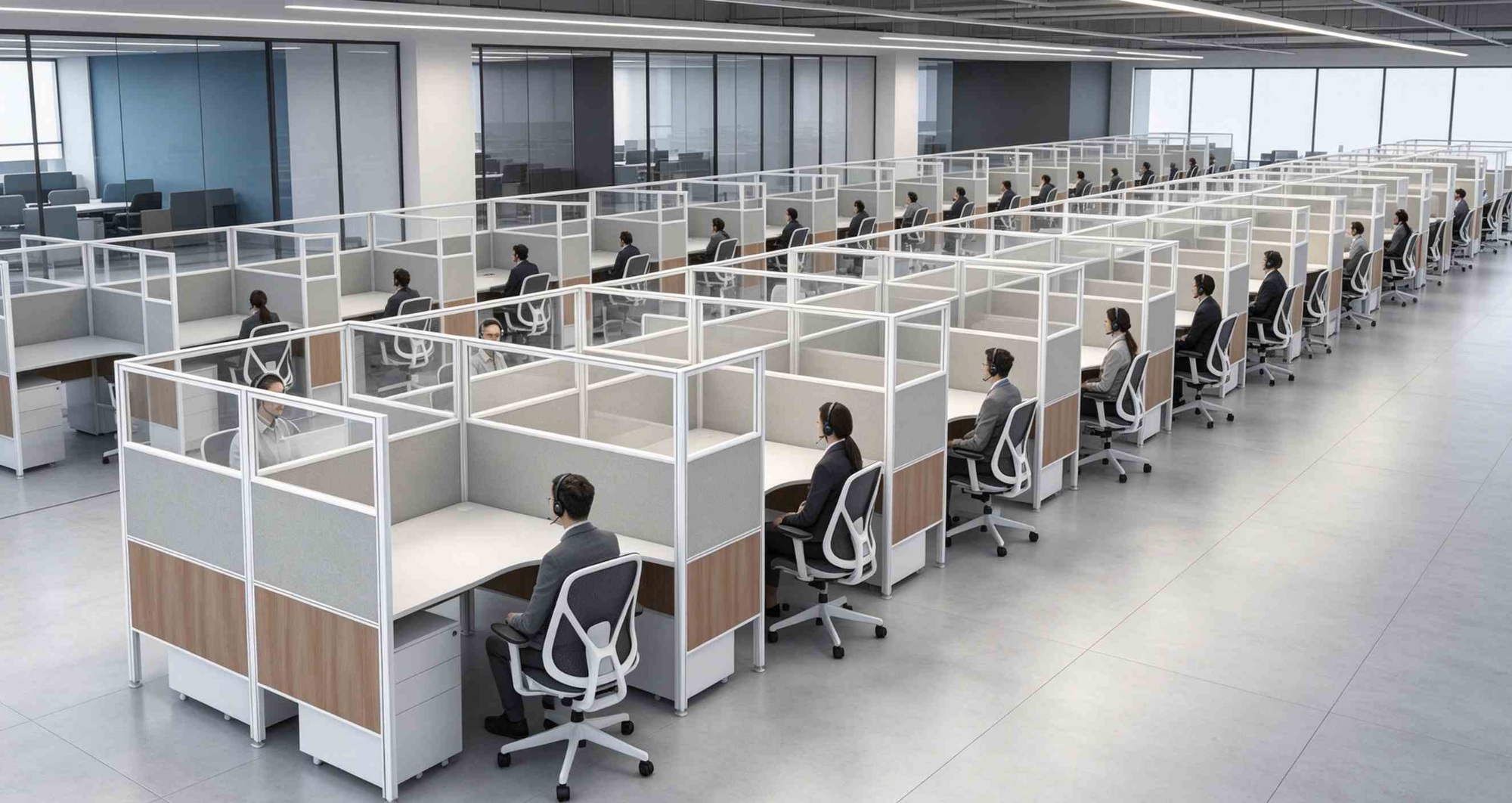
For call center projects requiring a balance between visual openness and privacy, the design featuring tempered glass upper sections is particularly popular. This configuration allows supervisors to quickly monitor agent status during floor walks while utilizing the fabric lower section to absorb ambient noise, thereby striking a balance between an open-plan layout and the need to maintain focus. This feature is especially valuable for settings sensitive to the acoustic environment, such as customer service call centers and technical support centers.
III. Desktop and Cable Management Systems: The Foundation of Efficiency and Safety
Designing desktops for call center workstations is far more than a simple matter of assembling tabletop with desk screen; it is a systematic undertaking centered on cable management and operational efficiency. In call center environments featuring continuous rows of workstations, factors such as tabletop stability, surface flatness, and the practicality of cable routing directly impact the project's final outcome and the subsequent day-to-day user experience.
Standard straight tabletops utilize 25mm-thick particleboard with straight-edge PVC banding and are secured to partition posts via compact support brackets. This structural design ensures a uniform, level surface across continuous workstation arrays, preventing issues like height mismatches or uneven seams and maintaining a neat, orderly layout. Notably, customization options—such as incorporating a client's logo—are available to align with corporate branding requirements.
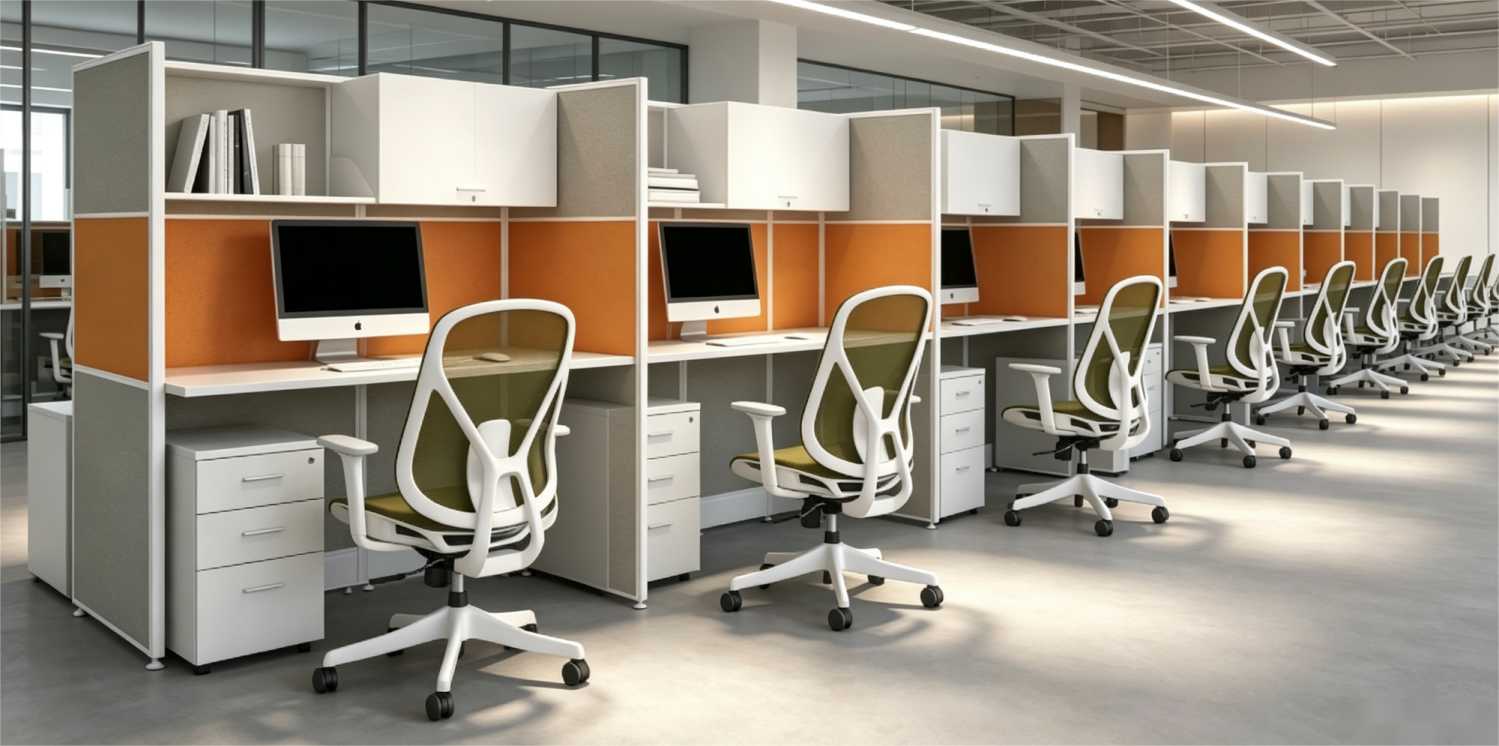
Configurations designed specifically for call centers, such as the T3 1650 Cubicle Room, feature integrated cable management channels tailored to handle the diverse wiring needs of workstation equipment. These channels simplify cable routing and effectively organize the complex web of wires found at each station. The system is designed for easy installation, eliminating common assembly hassles, reducing on-site construction time and complexity, and effectively meeting the demand for rapid project delivery in call center environments.
IV. Storage Systems: Overhead Units and Three-Drawer Steel Cabinets
Although call center workstations are typically compact, employees still require significant storage space for documents, headsets, and personal items. To address this, the T3 series offers overhead storage options for the upper zone (above 1650mm): a flip-up overhead cabinet featuring an all-MFC structure, 2mm PVC edge banding, and high-quality 14-inch flip-up slide hardware, complete with a handle and lock. This design provides ample suspended storage without occupying valuable floor space. For the area beneath the desk, an optional three-drawer steel filing cabinet is available; constructed from high-quality 0.7mm steel with an eco-friendly electrostatic powder-coated finish, it includes a branded lock and an interlocking mechanism to ensure moisture resistance, fire safety, and document security. A version featuring a wooden cabinet body with steel drawers is also available.
This "overhead plus under-desk" vertical storage approach resolves the issue of limited floor space in high-density workstation layouts. Furthermore, it enables standardized delivery through unified modules during bulk procurement, significantly shortening on-site installation and acceptance timelines—a crucial detail for builders and design firms managing the delivery of dozens of workstations in a single batch, as it helps minimize project management costs.
V. Seating for Daily Call Center Work
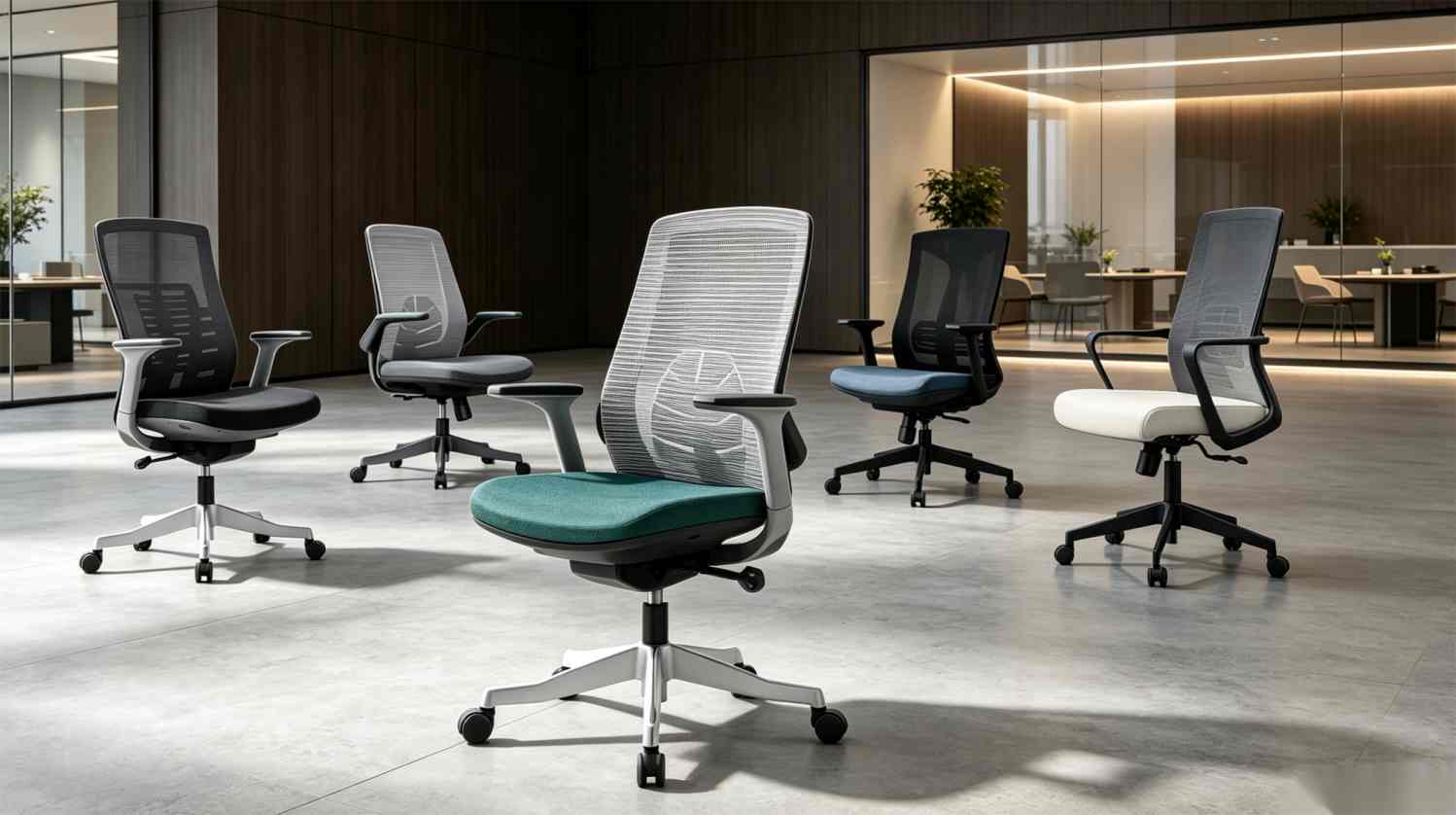
Call centers are characterized by sedentary work and high-intensity communication; thus, chair ergonomics directly impact employee fatigue levels and attendance rates. The selected office chairs feature a polypropylene (PP) frame, adjustable armrests, and a backrest capable of reclining between 108° and 138°. They are equipped with a PP+EVA lumbar support, a high-density mesh backrest, and a high-resilience foam seat cushion. Supported by an R330mm base and 60/25mm dual-color PA casters, these chairs ensure stability and comfort during prolonged use.
For call center seating, buyers should compare adjustability, lumbar support, upholstery, base stability, caster performance, test documentation, warranty terms, and compatibility with the intended work routine. Ergonomic features can support comfort, but health, attendance, and productivity outcomes depend on many factors and should not be presented as guaranteed results.
As a major global hub for call centers and BPO outsourcing, the Philippines exhibits distinct preferences regarding workstation staff chairs. Gray mesh backrests paired with lake-blue seat cushions are highly popular, creating visual depth amidst dark-colored partitions while maintaining a professional aesthetic. All-black models—valued for their stain resistance, versatility, and ease of maintenance—are the preferred choice for large-scale, standardized procurement. Mainstream configurations include a PP backrest frame with integrated lumbar support, a PP shell with high-resilience foam cushioning, fixed PP armrests, a tilt-lock mechanism, an aluminum alloy five-star base, and a gray overall frame. A matte aluminum base lends the product a "light business" aesthetic; these models are frequently used in reception and corporate-image-focused workstations, effectively meeting the needs of call center environments that require frequent movement and adjustment of open-plan workstations.
VI. How Does the System Address Call Center Procurement Challenges?
In actual projects, purchasers of call center workstations typically face several common challenges:
First is the conflict between noise and concentration; open-plan layouts often lead to call interference, but fabric screens combined with cable management channels can improve the acoustic environment without sacrificing workstation density.
Second are the safety and maintenance risks caused by cable clutter; flexible plastic cable conduits and base-level cable channels consolidate power and data cabling, reducing the risk of tripping and equipment damage while facilitating future IT maintenance.
Third are the tight timelines for bulk delivery; standardized modular structures—such as the T3-WS series, which offers tiered pricing based on the number of workstations (ranging from single units to ten-person rows)—allow builders to match configurations directly to the total number of seats, eliminating the wait times associated with custom designs.
Fourth are comfort concerns related to prolonged sitting. Chairs with suitable adjustment ranges can support different users, while product specifications and relevant test documents should be reviewed for the intended workplace.
Fifth is the need for brand consistency across multi-regional projects; a unified color customization system ensures visual consistency for a single client’s call center projects implemented in different countries and offices.
The systematic resolution of these five pain points represents the core value of a "one-stop furniture solution" compared to the piecemeal procurement of individual items.
Conclusion:
The ongoing evolution of global commercial real estate and hybrid work models is driving approximately 68% of enterprises to redesign their office layouts; notably, 57% have prioritized investments in ergonomic furniture, and the adoption rate of modular furniture has risen by about 34% year-over-year. For call centers—environments characterized by high-density occupancy and intensive usage—selecting a comprehensive solution that integrates partitions, desk systems, cable management, storage, ergonomic seating, and customizable color schemes not only accelerates project delivery but also reduces long-term maintenance costs and boosts employee retention.
For overseas contractors, interior design firms, and corporate buyers evaluating call center or large-scale open-plan office projects, a holistic assessment of suppliers based on four key dimensions—structural modularity, storage and cable management details, seating ergonomics, and customization flexibility for specific needs—serves as a practical strategy to ensure successful project delivery that meets all requirements from the outset.
For project-specific planning, specifications, and quotations, Contact M&W