
Freedom Open Office Spaces with Sit and Stand + Private Space: Height-Adjustable Partition Workstations
As open-plan offices become mainstream in corporate design, two major pain points continue to plague designers and professionals: severe visual and noise interference in open areas, resulting in a lack of focused space for employees; and prolonged sitting leading to neck and lumbar strain, making ergonomic requirements difficult to implement.
Modular partitions combined with electrically adjustable desks, through refined dimensional design, flexible assembly, and integrated functionality, simultaneously solve three major problems: privacy, health, and space utilization. They have now become a standard solution for internet companies, R&D firms, design firms, and government/enterprise offices.
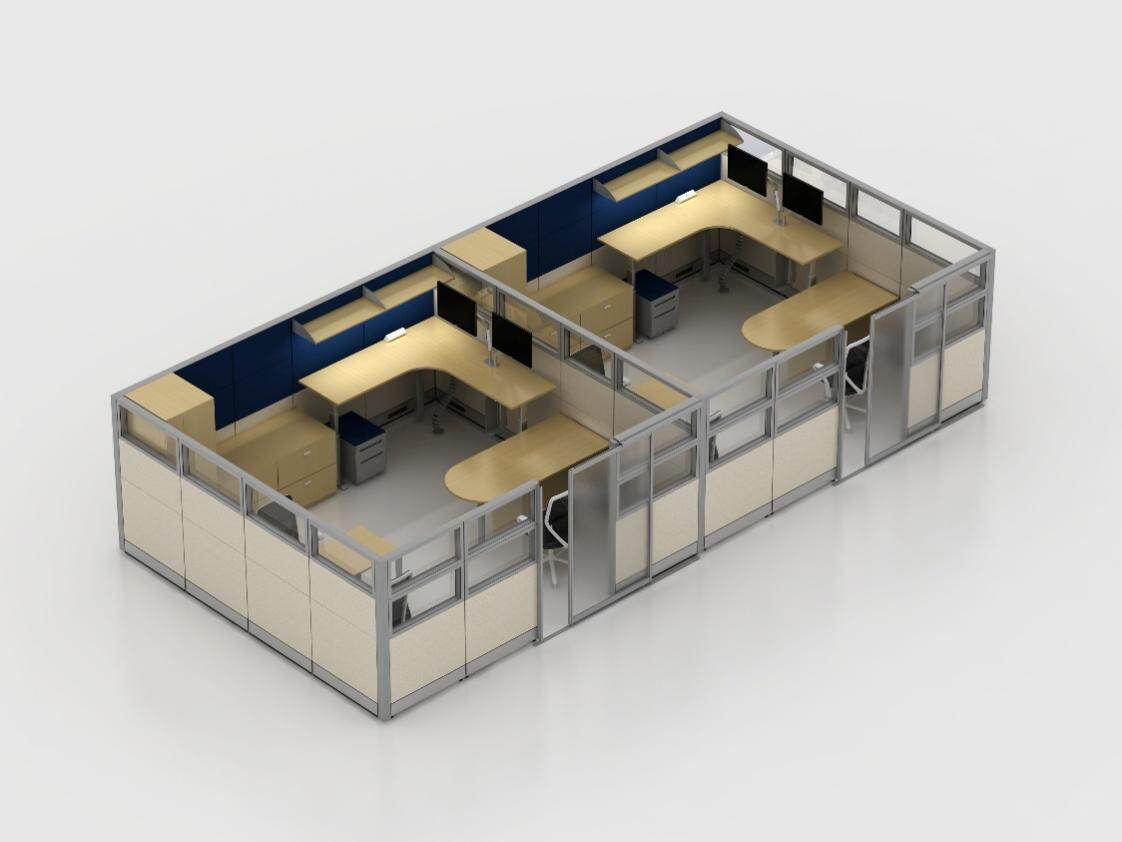
Below, from this article, you would know the practical value of this type of workstation in office spaces from three core dimensions: size, combination, and function.
I. Refined Layered Dimensional Design: Balancing Ergonomics and Privacy Boundaries
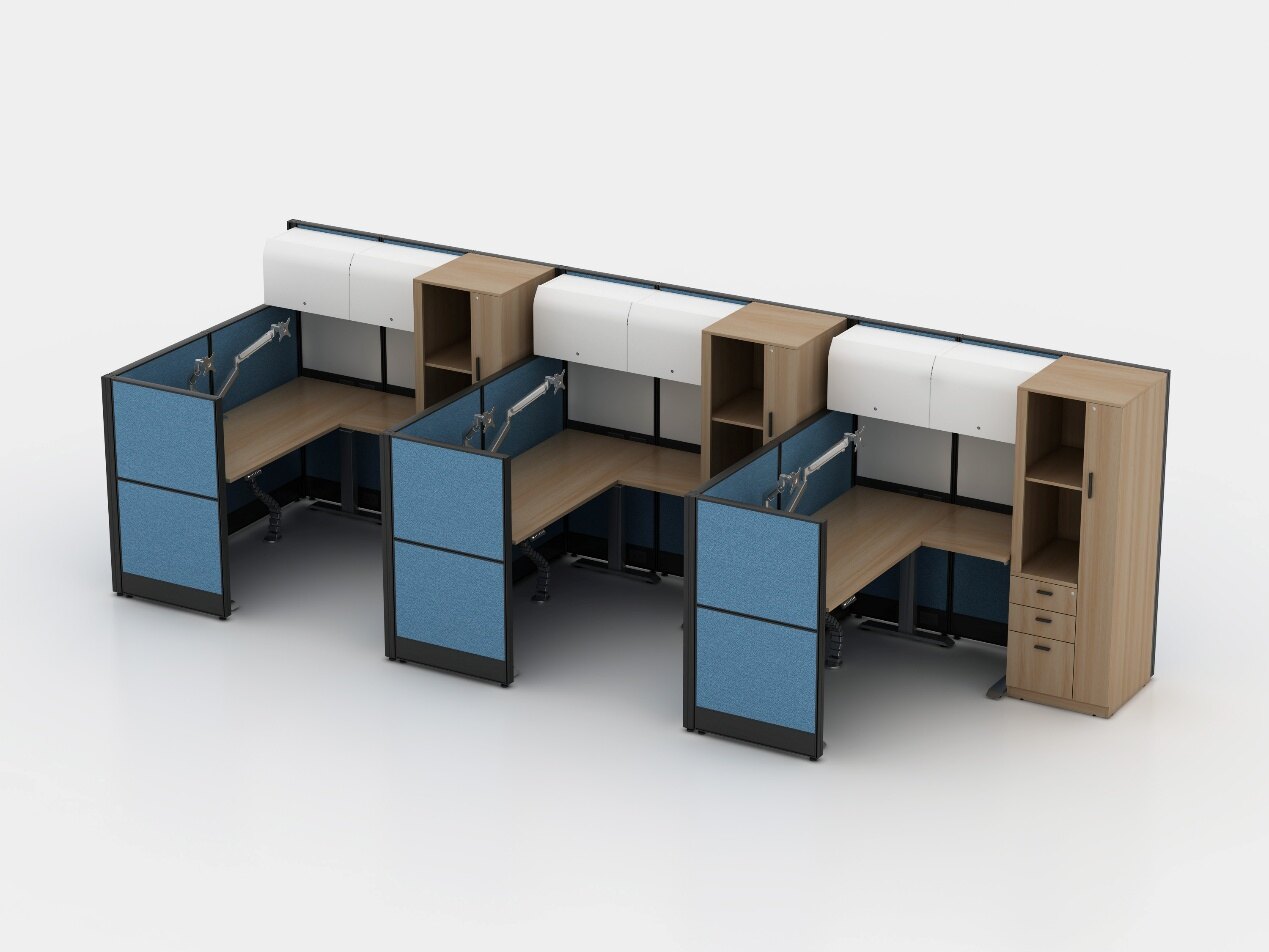
1. Electric Height-Adjustable Desk: Suitable for all users who alternate between sitting and standing while working.
Height Adjustment Range: Industry-leading dual-motor height-adjustable desk with an adjustment range of 720mm–1250mm. One-button memory for both sitting and standing heights eliminates the need for repeated adjustments.
L-Shaped Tabletop Dimensions: Standard single workstation depth is 1400-1800mm, with a side extension of 600-800mm in width, creating a dual-function area: the main area accommodates the monitor and keyboard at a natural arm reach; the side extension stores notebooks, paper documents, and water bottles, preventing clutter.
Under-Leg Space: The desk legs utilize a T-shaped floor-standing support without a central crossbar, leaving ample space underneath. This allows for comfortable legroom even when using a sliding cabinet, ensuring your legs can stretch freely while standing.
2. Office Partitions: Layered Heights Balancing Privacy, Lighting, and Communication
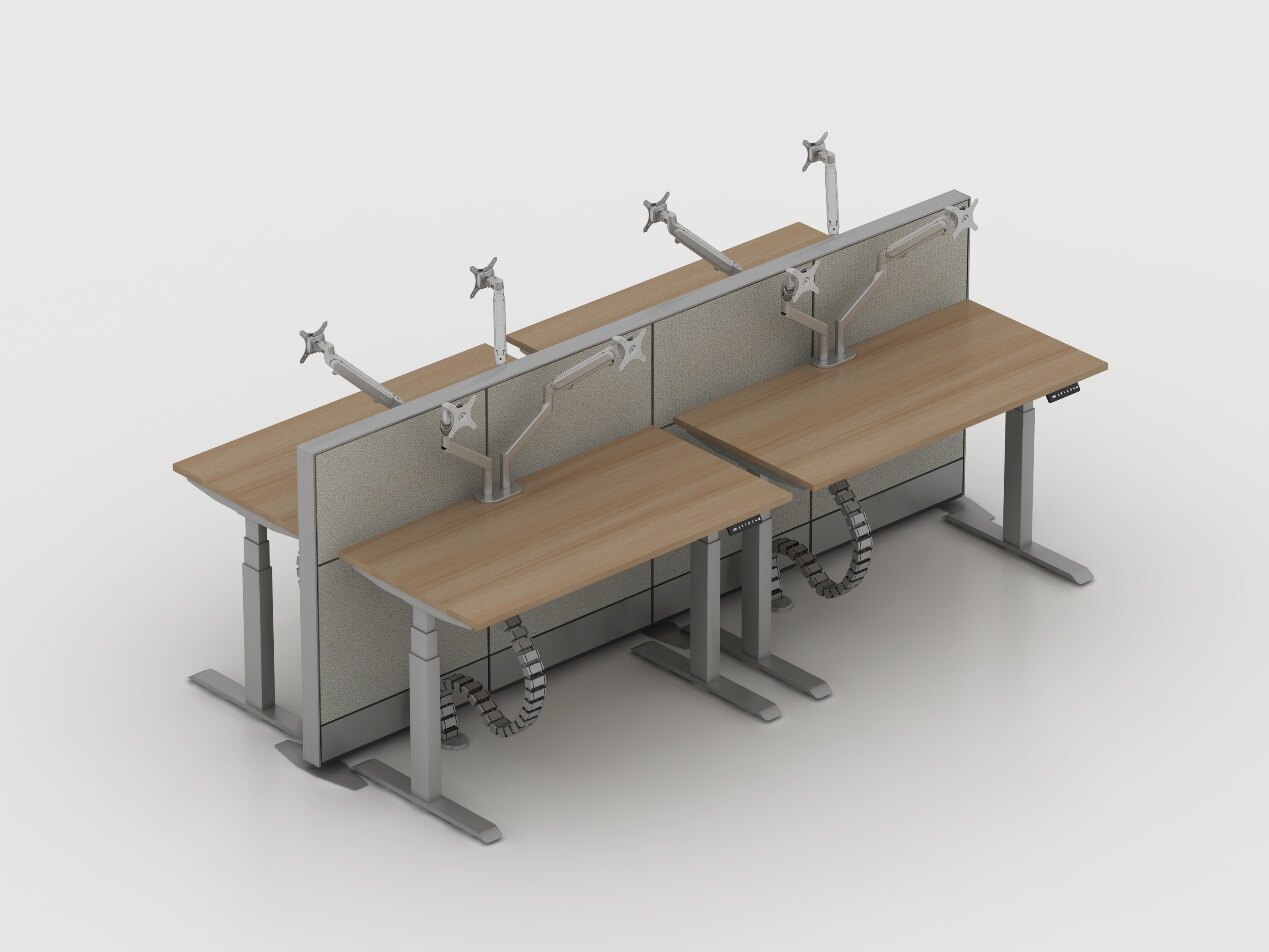
Partitions heights are not standardized, available in three sizes to suit different office scenarios:
Below 750mm Screen: Only blocks desktop clutter, suitable for creative open spaces, allowing teams to easily communicate by looking up;
Standard 1200mm panels: Completely blocks the view for adults in a seated position, preventing eye contact between adjacent desks, effectively protecting screen and paper document privacy while facilitating collaborative communication;
High 1500mm Full-Opaque partitions: Almost completely blocks the view, creating a private, independent workstation.
II. Modular and Flexible Combination: Adaptable to Different Sizes of Office Spaces
Traditional fixed desks can only be arranged in a straight line, while partitions + height-adjustable desks use standardized independent modular units. The single workstation is the smallest basic unit, which can be freely disassembled, combined, and reassembled to adapt to various office scenarios.
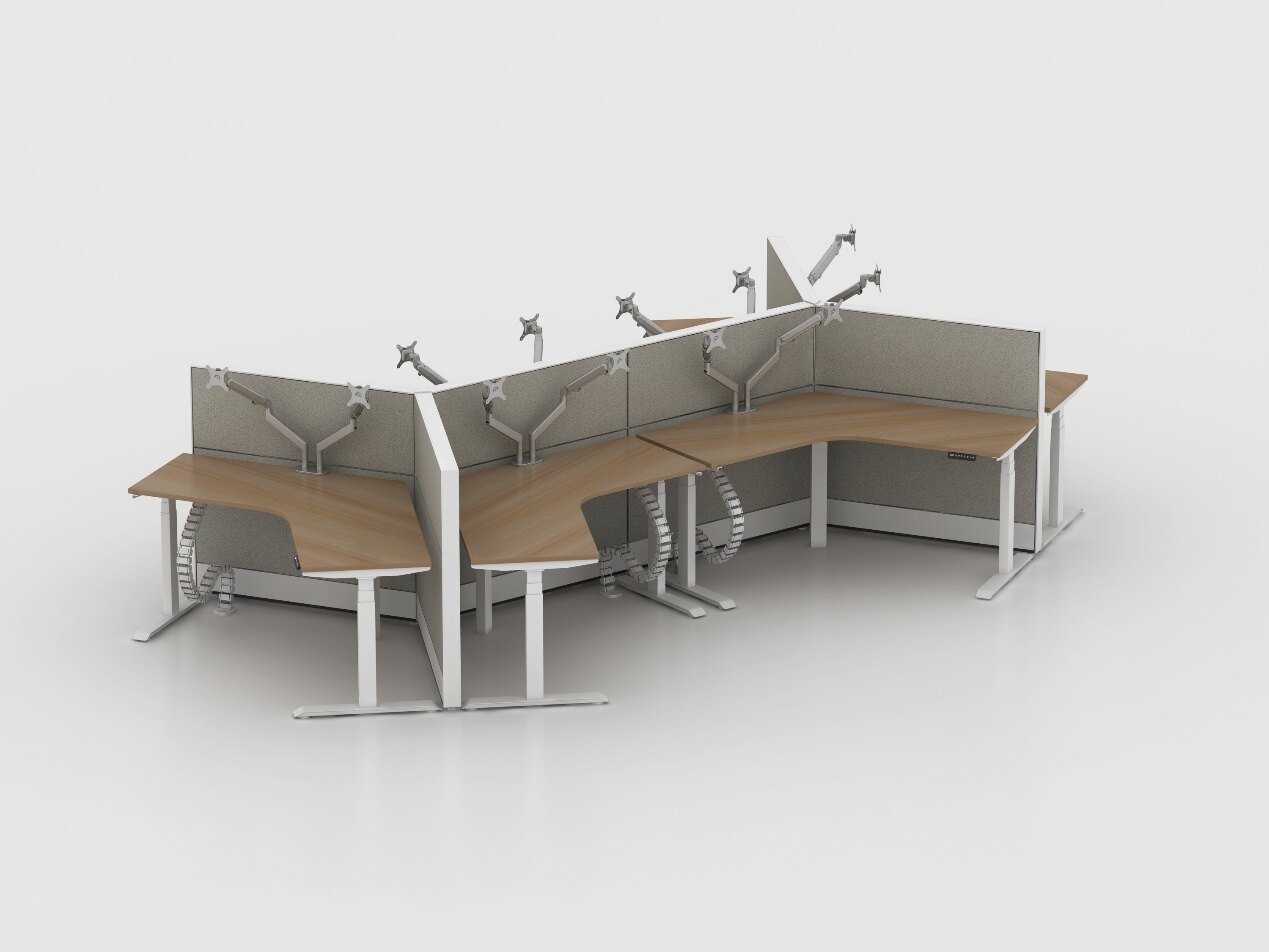
1. Basic Single Unit: Private, Independent Workstation
One L-shaped height-adjustable desk + three-sided enclosing screen, which can be placed alone near a window or in a corner area.
2. Straight-Line Row Combination: Standardized Employee Area for Large Numbers
Multiple straight/small L-shaped workstations are arranged back-to-back, side-by-side, sharing a double-sided partition screen. Each row can accommodate 6-12 people, often used in call centers.
3. Corner Enclosed Group Combination
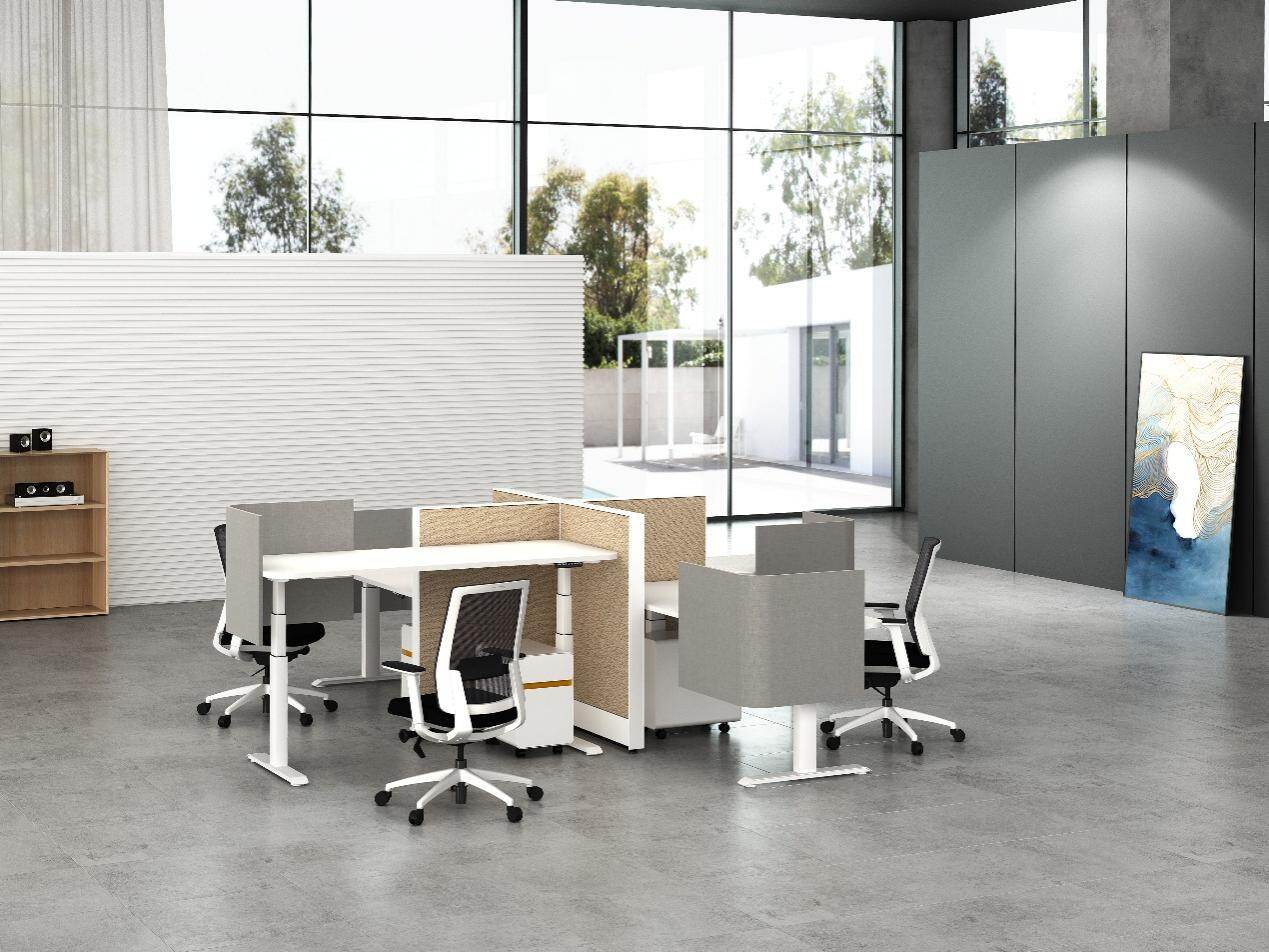
Four sets of L-shaped height-adjustable desks are joined diagonally at a 45° angle, with staggered partition screens forming a semi-enclosed 4-person group unit:
High Space Utilization: compared to straight-line arrangements, more employees can be accommodated in the same area; Collaboration + Privacy Balance: The four people in the group are close together; external partitions isolate noise and sightlines from other groups, allowing the group to focus independently;
Flexible Expansion: 4-person groups can be directly combined to expand into 6- or 8-person teams.
III. Integrated Multifunctional Design: The Workstation is a Complete Micro-Office Space
Unlike the traditional "desk is just a surface for storing things," the screen-and-lift workstation integrates storage, cable management, ergonomic accessories, and power supply systems, meeting all employee office needs in one place and reducing the need for additional furniture.
1. Ergonomic Features
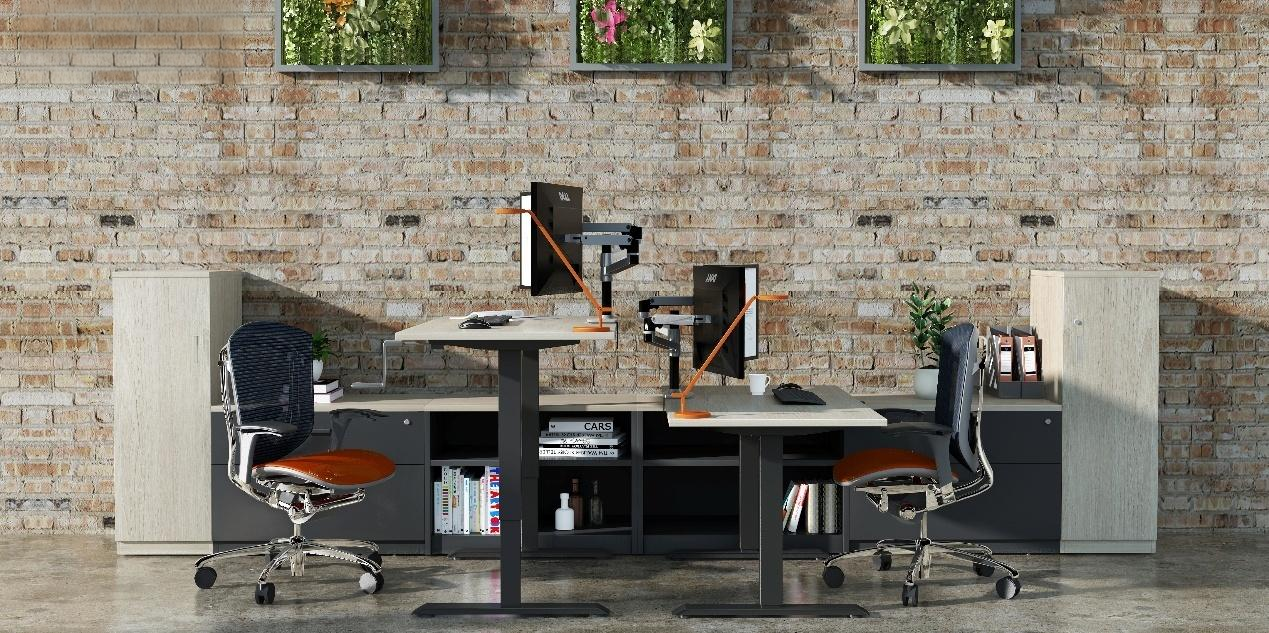
* Integrated Monitor Arm: The aluminum bracket is directly fixed to the screen frame, allowing for free adjustment of height and tilt angles for both single and dual-screen setups;
* Under-desk Serpentine Cable Management: Hides network cables, power cords, and charger cables, keeping the work surface tidy;
* Electric Height Adjustment with Memory Function: One-button switching to standing height after prolonged sitting, promoting healthy office work from a hardware perspective.
2. Integrated Storage and Acoustic Functions in the Partition
Soft-pack Sound Absorption and Noise Reduction: The partition is filled with high-density polyester sound-absorbing cotton, solving the noise problem in open-plan offices.
Embedded Power Supply Module: High-end models have a five-hole socket and USB fast charging port pre-installed at the bottom, eliminating the need for employees to use additional power strips and eliminating potential electrical safety hazards in the office.
3. Matching Desktop and Desk Storage
The L-shaped irregular desktop naturally divides the work area and storage area; it is paired with a matching series of mobile sliding cabinets and side flip-up storage for keyboards, contracts, and personal items; the height-adjustable desk has pre-drilled cable management holes for unified management of laptop and desktop computer cables.
IV. Implementation Summary
With the increasing prevalence of open-plan offices and rising employee health needs, partition screen + height-adjustable desk combination workstations are no longer exclusive to high-end offices. A set of standardized modular workstations can create an undisturbed, independent, and focused micro-space for employees, while also taking into account the needs of team collaboration. At the same time, it can achieve ergonomic office work by relying on the sit-stand alternation function. It is the optimal solution for office furniture that takes into account practicality, cost-effectiveness, and spatial aesthetics.